Promises in JavaScript Explained Through a Real-Life Date Story
Software Engineer | Passionate about Web Development, DSA & Problem Solving. I write simple, practical tech blogs to help developers learn and grow. Exploring JavaScript, C++, Backend & Modern Web Technologies.
What is a Promise in JavaScript?
A Promise in JavaScript is an object that represents the future result of an asynchronous operation.
In simple words :
A Promise is a guarantee that something will happen later, not right now.
That “something” can be:
✅ successful
❌ failed
But one thing is sure:
👉 JavaScript will not stay silent. It will respond.
Just like real life… especially relationships 😄
🤔 Why Do We Even Need Promises?
JavaScript is non-blocking.
That means:
JavaScript does not wait
It keeps running the next line
Long tasks happen in the background
Examples of async tasks:
API calls 🌐
Timers ⏱
File uploads
Database requests 🗄
Without Promises, handling these tasks becomes messy and confusing.
🔄 Promise States
Every Promise always stays in one of three states:
1️⃣ Pending – Work has started, result not ready
2️⃣ Fulfilled – Work completed successfully
3️⃣ Rejected – Work failed with a reason
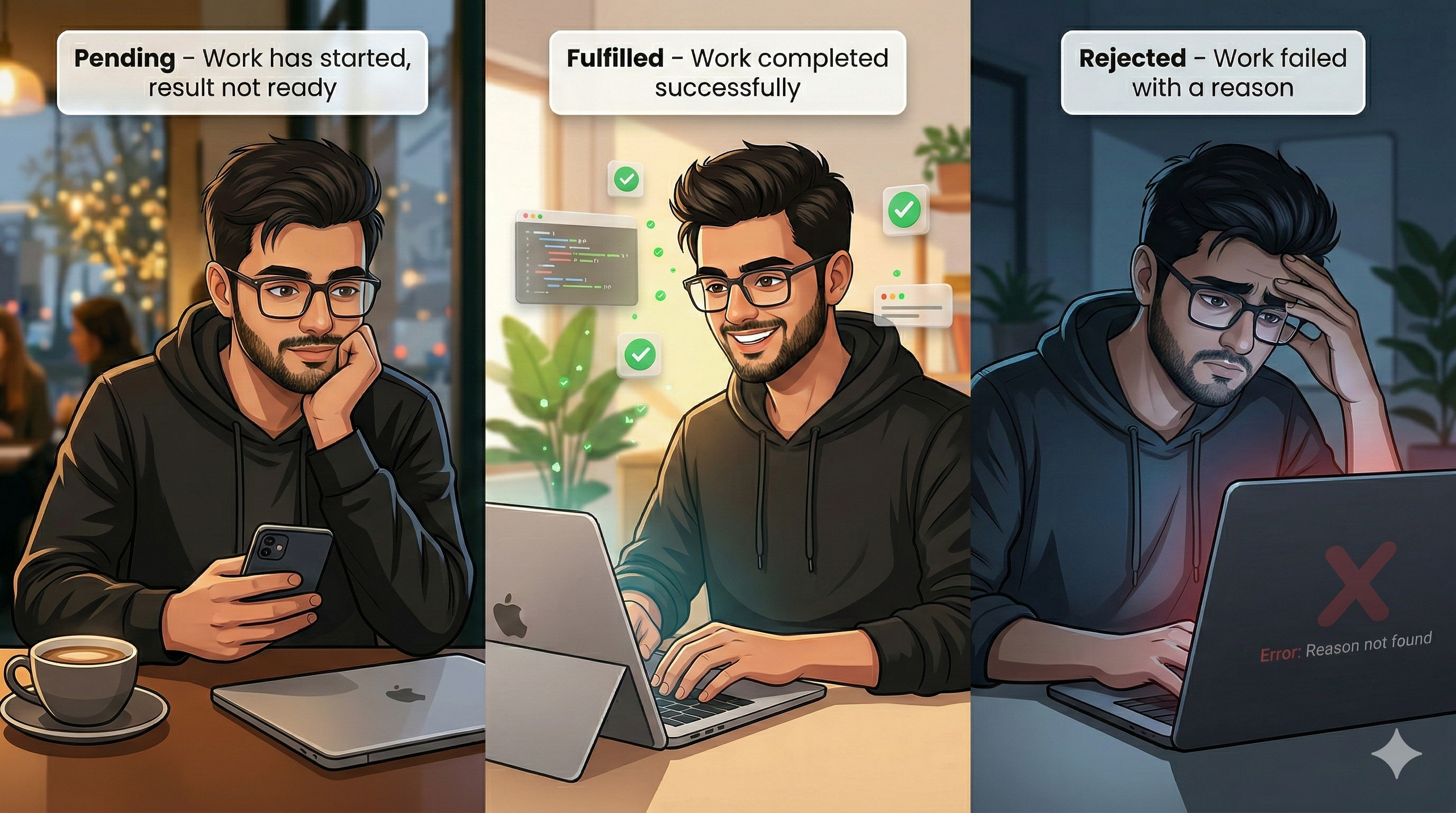
💌 JavaScript Promise States – A Love & Date Story
Piyush Gurg’s sir Date Night Plan
Piyush Gurg sir is single 💙
Focused on his career 👨💻
But like every human, he also believes in connection.
One evening, he plans a date.
Once the plan is made, the result is no longer in his control.
Exactly like a JavaScript Promise.
⏳ Pending State – The Waiting Phase

Piyush sir reaches the café on time.
He orders coffee ☕
He sits quietly and checks his phone 📱
The date may happen
or may not happen
Nothing is confirmed yet.
JavaScript Meaning:
promiseState = "PENDING";
🧠 Explanation:
Promise has started
JavaScript is waiting
No success, no failure yet
Just like Piyush sir waiting at the table 😌
💖 Fulfilled State – When Everything Goes Right

She arrives with a smile 😊
Conversation flows naturally
Time passes quickly
The date is successful ❤️
JavaScript Meaning:
promiseState = "FULFILLED";
🧠 Explanation:
Async task completed
Promise returned a value
Success path executed
This is the best-case scenario in both life and code.
💔 Rejected State – When Plans Fall Apart

No reply.
No message.
No explanation.
Piyush sir waits… then leaves.
JavaScript Meaning:
promiseState = "REJECTED";
🧠 Explanation:
Async task failed
Promise returned a reason
Error must be handled
Promises don’t hide failures — they communicate them clearly.
JavaScript Code Example – Date as a Promise
function dateNight() {
return new Promise((resolve, reject) => {
// ⏳ Promise starts here (Pending state)
console.log("Piyush sir is waiting for the date...");
setTimeout(() => {
const sheArrived = true; // change to false to see rejection
if (sheArrived) {
// ✅ Fulfilled state
resolve("The date went really well ❤️");
} else {
// ❌ Rejected state
reject("The date got cancelled 💔");
}
}, 2000); // waiting time
});
}
// Handling the Promise
dateNight()
.then((successMessage) => {
// Runs when resolve() is called
console.log("SUCCESS:", successMessage);
})
.catch((errorMessage) => {
// Runs when reject() is called
console.log("FAILURE:", errorMessage);
})
.finally(() => {
// Runs in both cases
console.log("Date plan closed. Moving on 🚶♂️");
});
Promise Methods Explained
.then() – After Success
Runs only when the Promise is fulfilled.
Meaning:
Piyush sir’s date went well.
Good conversation, good vibes.
So after success, he plans the next meet confidently.
promise.then((result) => {
  console.log(result);
});
.catch()– Handling Rejection
Runs only when the Promise is rejected.
Meaning:
The date got cancelled.
Piyush sir didn’t panic or overreact.
He accepted the situation calmly and moved on.
promise.catch((error) => {
  console.log(error);
});
.finally() – Closure Is Important
Runs no matter what happens.
Just like life —
success ho ya failure, closure zaroori hai.
Date successful ho ya cancel,
Piyush sir still goes home, reflects, and sleeps peacefully.
No loose ends.
promise.finally(() => {
  console.log("Emotional cleanup done 🧠");
});
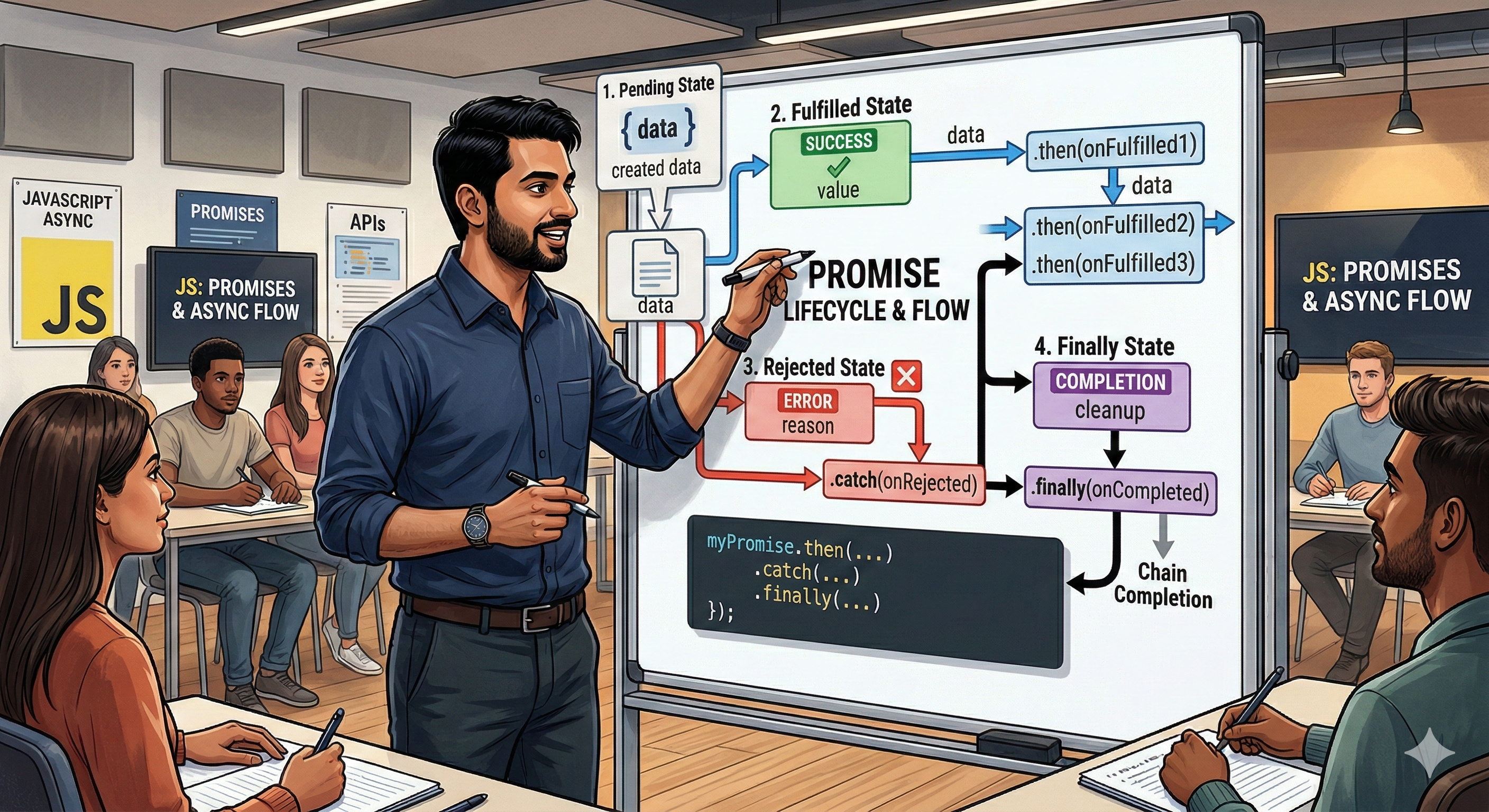
Multiple Promises – Real-Life Situations
Promise.all() – Everything Must Work
Meaning:
Piyush sir planned dinner, movie, and cab.
If even one plan failed, the whole night failed.
Promise.all([bookTable(), orderFood(), arrangeRide()])
  .then(() => {
    console.log("Perfect date setup ❤️");
  });
Fails if even one task fails.
😊 Promise.any() – One Success Is Enough
Meaning:
Several plans didn’t work.
But one meaningful conversation clicked — and that was enough.
Promise.any([firstDate(), secondDate(), blindDate()])
  .then((result) => {
    console.log("At least one connection worked 💫");
  });
📝 Promise.allSettled() – Accepting All Outcomes
Meaning:
Some dates were good.
Some were awkward.
Piyush sir accepted every experience as a lesson.
Promise.allSettled([dateOne(), dateTwo()])
  .then((results) => {
    console.log(results);
  });
Success + failure — both matter.
⚡ Promise.race() – Whoever Responds First
Meaning:
Whoever replied first — that plan moved forward.
Timing matters.
Promise.race([replyFromHer(), replyFromOther()])
  .then((result) => {
    console.log("First response received 📩", result);
  });

🎯 Conclusion
JavaScript Promises teach us an important life lesson:
You can’t control outcomes
You can only handle them correctly
Promises help us:
write clean async code ✨
avoid callback hell 😵
manage success and failure clearly
Just like relationships ❤️
**Wait patiently.
Handle responses honestly.
And always close the loop.**


